Thursday, 5 February 2009
Tuesday, 3 February 2009
Colles Fracture
Steph
Tuesday, 27 January 2009
Monday, 26 January 2009
M5
Best of luck, everybody.
Sunday, 25 January 2009
Reply to emma about m4
mistake in scenario 2
Anterior draw test
The anterior draw test .. the pulling the tibia etc .
i have pulling the calcaneus upwards on the foot as anterior draw test too .. is that the wrong name?!
Steph :)
XXX
M1
For m1 .. the medial meniscus an MCL .. does this test test both of them ? .. e.g if its positive the tibia moves .. due to loose ligament or due to tear in meniscus .. ?
Anterior drawer test; patient supine with hips flexed to 45 degrees and knees flexed to 90 degrees. Stabilize foot. Apply posterior force to tibia. Positive sign; tibia moves more than 6mm on the femur
Steph :)
X
M4
Saturday, 24 January 2009
Friday, 23 January 2009
M7
You can find it on the m7 link at the side of the page
Enjoy
STEWWW!
As for t6 still waitin for the notes .. todays post hopefully ..
XX
T7
Thursday, 22 January 2009
T10
1st measure the crutch length
get patient to stand up against the bed with the assistants help as the physio measures from the ulnar styloid to the ground.
the patients arms must be flexed to approx.15 degrees
the handle should be equal to this height ..
Thankyou ...
Steph :)
XXX
quick question for T1
T3
Walking:·
Position a chair an appropriate distance from the patient.·
Demonstrate using a 3point gait – used for non-weight bearing on one leg, hop too and hop through.
a little confused ..
Steph :)
x
Wednesday, 21 January 2009
T8 the spine Func Analysis ... Niamh ..
Head flexed due to pillow, shoulders on bed and thoracic spine. Although due to the curvature shape of the lumbar spine (lordotic) it is slightly off the bed.
PHASE 2: Head flexes further (saggital), rotation (transverse) and is then placed back on pillow and for this to happen, head & neck is laterally flexed (saggital), muscles working eccentrically for head to lower.
Thanks
Steph :)
XXX
T6 - Functional Analysis
Sorry :(
Steph XX
Tuesday, 20 January 2009
Imflammation process 2 ...
- when activated by infection agents such as infection or trauma, they rrelase inflammatory mediators that are responsible for the inflmmation,
- Vasodilation occurs; this is responsible for the increased blood flow to the area; causing redness, and the increased in skin temperature
- loss of function is due to neurological reflex in response to pain.
:)
XX
Inflammation Process ...
Inflammation (Latin, inflamatio, to set on fire) is the complex biological response of vascular tissues to harmful stimuli, such as pathogens, damaged cells, or irritants. It is a protective attempt by the organism to remove the injurious stimuli as well as initiate the healing process for the tissue. Inflammation is not a synonym for infection. Even in cases where inflammation is caused by infection, the two are not synonymous: infection is caused by an exogenous pathogen, while inflammation is the response of the organism to the pathogen.
In the absence of inflammation, wounds and infections would never heal and progressive destruction of the tissue would compromise the survival of the organism. However, inflammation which runs unchecked can also lead to a host of diseases, such as hay fever, atherosclerosis, and rheumatoid arthritis. It is for this reason that inflammation is normally tightly regulated by the body.
Inflammation can be classified as either acute or chronic. Acute inflammation is the initial response of the body to harmful stimuli and is achieved by the increased movement of plasma and leukocytes from the blood into the injured tissues. A cascade of biochemical events propagates and matures the inflammatory response, involving the local vascular system, the immune system, and various cells within the injured tissue. Prolonged inflammation, known as chronic inflammation, leads to a progressive shift in the type of cells which are present at the site of inflammation and is characterised by simultaneous destruction and healing of the tissue from the inflammatory process.
Hope this helps!
XX
Monday, 19 January 2009
M11...
Inflammatory cycle???
M6 mistake
Friday, 16 January 2009
More bits for m13
inflammation process
Thursday, 15 January 2009
Rob
Wednesday, 14 January 2009
Question T10
Justin I just looked at your write up of T10 - Its still different to the work we did in class on the last day of term - check out the video of T10 - after 12:30 minutes - catherine's demo of the stair ascent is different from your account - any ideas anyone ?
M6
M12
Radioulnar joint - Radial head and coronoid process of ulna ..
Does the radius have 2 heads, because these joints are at two opposite ends of the arm?
Steph X
Tuesday, 13 January 2009
Videos
Follow instructions in the top right hand corner to access T1 -> T7 & T9 on You Tube - on channel "superhoofy"
Click on T8
T10
or T11 to see these at google video site - they are longer and won't fit on you tube. They are still somewhat "private" - you cant find them through search engines.....
M4 --> A MORE BEEFED UP VERSION!!!!!!!!!!!!
Subjective assessment
30 year old maleDiagnosed with inversion sprain Pain when weight bearing on injured leg and requires crutches. PMH - NilDH - NilSH - Working as a delivery man, keen to return to activities as soon as possible.Lives with girlfriend in a 2nd strey flat.
History of present condition:
· 3 days ago-overbalanced at work while loading parcels into van.
· Twisted weight-bearing plantarflexed foot sustaining an iversion sprain to left ankle.
· No breakage or fracture.
Expected Signs & symptoms:
Severe sprain-
· Complete tear to muscle.
· significant muscle weakness and severe loss of function.
· Severe pain followed by no pain.
· Minimum to no pain on isometric contraction.
· Bruising (ecchymosis), swelling, and tenderness
· Gross joint instability.
· Pronounced limp in left foot during left stance of gait cycle,weight bearing causing obvious pain.
· Inversion and planatarflexion aggravate condition.
· Possible haemarthrosis
Objective Assessment: tests to determine if there is any abnormal motion at the joint which would indicate how badly a ligament has been torn.
Active movements:
Plantarflexion – 0-15
Dorsiflexion – 0-55
Inversion – 0-20
Eversion – 0-10
Passive movements(assissted):
Plantarflexion
Dorsiflexion
Inversion
Eversion
Special Tests:
Anterior drawer sign:-
Tests lateral ligament and medial ligament integrity.
Patient prone with knee flexed.
Apply posteroanterior force to talus with ankle in dorsiflexion and then plantarflexion.
Expected signs- excessive anterior movement(both ligaments affected) or movement on both side only(ligament on that side afffected)
Talar tilt:-
Tests –in adduction tests mainly the integrity of calcaneofibular ligament but also anterior talofibular ligament.
-in abduction tests integrity of deltoid ligament.
Patient lying prone,supine or on side with knee flexed.
Tilt talus into abduction and adduction with patients foot in neutral.
Positive sign- excessive movement.
Thompsons test:-
Tests Achilles tendon rupture.
Patient lying in prone position with feet over edge of plinth.
Squeeze calf muscle.
Positive sign-absence of plantarflexion.
Gait analysis:-
Pronounced limp in left foot during left stance of gait cycle,weight bearing causing obvious pain.
Basic anatomy of ligaments in ankle
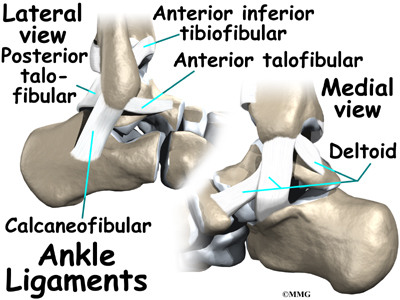
Three ligaments make up the lateral ligament complex on the side of the ankle farthest from the other ankle. (Lateral means further away from the center of the body.) These include the anterior talofibular ligament (ATFL), the calcaneofibular ligament(CFL), and the posterior talofibular ligament (PTFL). A thick ligament, called the deltoid ligament, supports the medial ankle (the side closest to your other ankle).
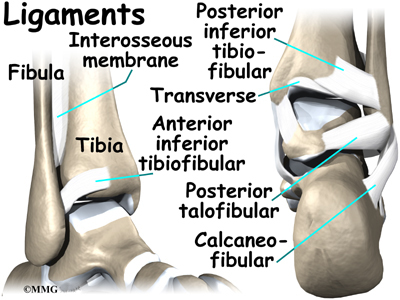
Ligaments also support the lower end of the leg where it forms a hinge for the ankle. This series of ligaments supports the ankle syndesmosis, the part of the ankle where the bottom end of the fibula meets the tibia. Three main ligaments support this area.
The thin, flat ligament crossing just above the front of the ankle and connecting the tibia to the fibula is called the anterior inferior tibiofibular ligament (AITFL).From tip of fibula to lateral talar neck.
The posterior fibular ligaments attach across the back of the tibia and fibula. These ligaments include the posterior inferior tibiofibular ligament (PITFL) and the transverse ligament. The interosseous ligament lies between the tibia and fibula. (Interosseous means between bones.) The interosseus ligament is a long sheet of connective tissue that connects the entire length of the tibia and fibula, from the knee to the ankle.Short lig. posteriorly fibula-talus.
CFL –cord like structure directed inferiorly and posteriorly to calcaneus.
ATFL most comonly injured,inversion during plantarflexion is main cause of sprain.
In plantarflexion ATFL is under tension and susceptible to injury.CFL may also be injured.
Onset of P important and ability to weight bear immediately after injury.
Uneven terrain , previous injury, badly fitted shoes.
What is an ankle sprain?
An ankle sprain occurs when there is a stretch or tear in one or more of the ankle ligaments and/or soft tissue of a joint caused by sudden adduction . Ankle ligaments are slightly elastic, fibrous bands of tissue that keep the anklebones in place.
Depending on the severity of the injury, an ankle sprain is classified as follows:
· Grade I - Pain is present(mild), but there is minimal ligament damage and minimal loss of function. Mild stretch ATFL, stretch to partial tear of ligament
· Grade II - There is moderate ligament damage and moderate pain ,with a somewhat loose ankle joint.Complete rupture of ATFL without CF invlovement and other sprains with partial tearing of both.
· Grade III - One or more ligaments is completely torn, and the ankle joint is very loose or unstable. Loss of function and severe swelling.
A third –degree sprain of the lateral ankle,which usually occurs as a result of severe inversion injury, causes a complete tear or rupture of the anterior talofibular (ATF) ligament, often the calcaneofibular (CF) ligament, and occasionally the posterior tibiofibular (PTF) ligament. When the ATF and CF ligaments are both torn and subtalar joints. The ATF ligament is most likely to tear when forceful inversion occurs while the ankle is plantarflexed. Associated injuries that occur include a transverse fracture of the lateral malleollus or an avulsion fracture of the base of the 5th metatarsal (both have been ruled out in this case study).
85% of ankle sprains are inversion sprains.This is due to the fibula extending further than the tibia.this length difference results in more eversion vs the tibia.
Deltoid complex is much stronger than the lateral ligament complex of ATFL,PTFL and CF.
In addition to significant pain,swelling and tenderness, a complete tear of one or more lateral ligaments causes a marked mechanical instability and functional instability of the ankle during weight bearing activities. This generally requires crutches.
Mechanical instability is defined as ankle mobility beyond the physiological ROM, increased talar tilt, and an anterior drawer sign. Functional instability is characterized by the sensation of the ankle “giving way” experienced by the patient. As many as 20% of pts without evidence of mechanical instability complain of their ankle giving way after severe lateral ankle sprain, thus significantly impairing functional activities.
After acute, grade 3 inversion injury, nonoperative treatment is successful for most patients. However some patients sustain recurrent inversion injuries after the acute injury has healed and develop chronic, symptomatic instability. For patients with demonstrated mechanical instability who do not respond to nonoperative management and for selected patients with acute lateral ankle injuries who regularly engage in high impact activities, surgical repair or reconstruction may be required to manage the instability and return the patient to the desired level of function.
Goals of surgery and postoperative management is to restore joint stability while pain free, functional ROM of the ankle and the subtalar joints.
Indications of surgeryÃ
Frequently cited indication for surgical repair of the soft tissue of the lateral aspect of the ankle
Chronic mechanical and functional instability of the ankle during activity,which remains unresolved after conservative management.
Acute, third degree lateral ankle sprain resulting in a complete tear of the ATF and/or CF ligaments.
What is Acute Inflammation? Inflammation is the body’s normal protective response to an injury, irritation, or surgery. This natural “defense” process brings increased blood flow to the area, resulting in an accumulation of fluid. As the body mounts this protective response, the symptoms of inflammation develop. These include:
Swelling
Pain
Increased warmth and redness of the skin
Inflammation can be acute or chronic. When it is acute, it occurs as an immediate response to trauma (an injury or surgery)—usually within two hours. When it is chronic, the inflammation reflects an ongoing response to a longer-term medical condition, such as arthritis.
Inflammation is not the same as infection. Infections are caused by bacteria, fungus, and viruses, and infections sometimes produce inflammation. However, infection and inflammation are treated very differently. Your foot and ankle surgeon can best determine the cause of your inflamed tissue.
Treatment To reduce inflammation and the resulting swelling and pain, injured tissue needs to be properly treated. The earlier you start treatment, the better.
Treatment for acute inflammation consists of “RICE” therapy—which stands for Rest, Ice, Compression, and Elevation. For acute inflammation in the foot or ankle, your foot and ankle surgeon will recommend "RICE" therapy.
Rest. Stay off of your foot as much as possible to prevent further injury. In some cases, complete immobilization may be required. Your doctor will decide whether you will need crutches and whether movement of your foot or ankle is appropriate.
Ice. Icing, which decreases blood flow to the tissue, thus reducing swelling and pain, should be continued until your symptoms resolve. Wrap ice cubes—or a bag of frozen peas or corn—in a thin towel and place the pack on the injured area for 20 minutes of each hour you’re awake. If your skin turns blue or white, discontinue icing for a few hours. Two cautions: Never apply ice or frozen bags directly to your skin. And never leave an ice pack on your injury while you sleep.
Compression. Keep the inflamed area compressed by wrapping it in an elastic bandage or stocking. Compression prevents additional fluid accumulation and helps reduce pain. Wrap the bandage more firmly at the toes and less firmly at the calf. If your toes tingle or your foot throbs, the wrapping may need to be loosened. If the tingling or throbbing continues after loosening the wrap, contact your doctor as soon as possible.
Elevation. Keeping the foot elevated reduces the swelling by allowing excess fluid to drain to the heart. The proper way to elevate your foot is to keep it level with or slightly above the heart. Place one or two pillows under your calf, and make sure your hip and knee are slightly bent. Never keep your leg extended straight out.
What is Acute Inflammation? Inflammation is the body’s normal protective response to an injury, irritation, or surgery. This natural “defense” process brings increased blood flow to the area, resulting in an accumulation of fluid. As the body mounts this protective response, the symptoms of inflammation develop. These include:
Swelling
Pain
Increased warmth and redness of the skin
Inflammation can be acute or chronic. When it is acute, it occurs as an immediate response to trauma (an injury or surgery)—usually within two hours. When it is chronic, the inflammation reflects an ongoing response to a longer-term medical condition, such as arthritis.
Inflammation is not the same as infection. Infections are caused by bacteria, fungus, and viruses, and infections sometimes produce inflammation. However, infection and inflammation are treated very differently. Your foot and ankle surgeon can best determine the cause of your inflamed tissue.
Treatment To reduce inflammation and the resulting swelling and pain, injured tissue needs to be properly treated. The earlier you start treatment, the better.
Treatment for acute inflammation consists of “RICE” therapy—which stands for Rest, Ice, Compression, and Elevation. For acute inflammation in the foot or ankle, your foot and ankle surgeon will recommend "RICE" therapy.
Rest. Stay off of your foot as much as possible to prevent further injury. In some cases, complete immobilization may be required. Your doctor will decide whether you will need crutches and whether movement of your foot or ankle is appropriate.
Ice. Icing, which decreases blood flow to the tissue, thus reducing swelling and pain, should be continued until your symptoms resolve. Wrap ice cubes—or a bag of frozen peas or corn—in a thin towel and place the pack on the injured area for 20 minutes of each hour you’re awake. If your skin turns blue or white, discontinue icing for a few hours. Two cautions: Never apply ice or frozen bags directly to your skin. And never leave an ice pack on your injury while you sleep.
Compression. Keep the inflamed area compressed by wrapping it in an elastic bandage or stocking. Compression prevents additional fluid accumulation and helps reduce pain. Wrap the bandage more firmly at the toes and less firmly at the calf. If your toes tingle or your foot throbs, the wrapping may need to be loosened. If the tingling or throbbing continues after loosening the wrap, contact your doctor as soon as possible.
Elevation. Keeping the foot elevated reduces the swelling by allowing excess fluid to drain to the heart. The proper way to elevate your foot is to keep it level with or slightly above the heart. Place one or two pillows under your calf, and make sure your hip and knee are slightly bent. Never keep your leg extended straight out.
Monday, 12 January 2009
T9 - Functional Analysis
Amputee Transfer – Bed to wheelchair – Functional Analysis – Leading arm.
Starting position
Patient is sat on the edge of the bed with both arms on the edge of the bed ready to push off.
Shoulder slightly extended – Latissimus dorsi, teres major, pectoralis major, deltoid (posterior fibres), triceps (long head) – Sagittal plane
Shoulder internally rotated – Due to pronation of elbow – Transverse plane
Elbow fully extended – Triceps brachii, Anconeus - Sagittal plane
Elbow pronated – Pronator teres, pronator quadratus
Isometric muscle contractions
Wide BOS – Sat on bed; plus area underneath bed, feet on floor
COG – head to pelvis
LOG – through pelvis and bed
Friction is acting upon patient continuously; feet and floor, bum and bed, hands and bed
Phase 1
Patient’s leading arm reaches over to the chair arm of the wheelchair.
Shoulder flexes - Pectoralis major, deltoid (anterior fibres), biceps brachii (long head), and coracobrachialis - Sagittal plane
Shoulder abducts - Supraspinatus, deltoid (middle fibres) – Coronal axis
Shoulder still internally rotated - Transverse plane
Elbow extends – Triceps brachii, Anconeus - Sagittal plane
Elbow still pronated – Pronator teres, pronator quadratus
All CONCENTRIC muscle contractions.
Patients moves out of LOG + COG (not within body), therefore slightly less stable, but compensated for by the larger BOS; achieved by using the chair as extra BOS.
Friction continuously acting on the patient through the feet and the floor, bed and bum, hand and bed, hand and wheelchair arm
Phase 2
Patient pushes of the bed with opposite arm and leading arm takes the weight on the wheelchair arm.
Shoulder; slight extension – Latissimus dorsi, teres major, pectoralis major, deltoid (posterior fibres), triceps (long head) - Sagittal plane – Eccentric muscles contraction
Elbow flexes – Biceps brachii, brachialis, brachioradialis, pronator teres - Sagittal plane – Eccentric muscle contraction
Elbow pronates more – Pronator teres, pronator quadratus
Shoulder still abducted, but adducts slightly - Coracobrachialis, pectoralis major, Latissimus dorsi, teres major - Coronal axis – Eccentric muscle contraction
BOS – Feet on the floor and hand on the chair.
LOG – within the body but not through the centre
COG – within the body
Friction is continuously acting on the patient; feet and floor and the hand and the wheelchair arm.
Phase 3
Patient pivot turns around ready to sit down in the chair.
Shoulder extends – Latissimus dorsi, teres major, pectoralis major, deltoid (posterior fibres), triceps (long head) - Sagittal plane
Shoulder adducts more – Coracobrachialis, pectoralis major, latissimus dorsi, teres major - Coronal axis
Shoulder internally rotates – due to pronation of elbow - Transverse plane
Elbow flexes – Biceps brachii, brachialis, brachioradialis, pronator teres - Sagittal plane
Elbow pronates – Pronator teres, pronator quadratus
All ECCENTRIC muscle contractions
BOS - the floor and hand on the chair, although slightly wider and more stable as the patient is much closer to the larger BOS; the chair.
LOG + COG within body
Friction is continuously acting upon the patient; floor and feet and the hand and the wheelchair arm, although more friction between the hand and the wheelchair arm as there is more weight put through the hand at this point than in phase 3.
Phase 4 – Finishing position
Patient sits back into wheelchair and relaxes.
Shoulder flexes – Pectoralis major, deltoid (anterior fibres), biceps brachii (long head), coracobrachialis - Sagittal plane
Shoulder internally rotates – due to pronation of elbow - Transverse plane
Shoulder adducts fully back to side of body - Coracobrachialis, pectoralis major, latissimus dorsi, teres major - Coronal axis
Elbow flexes – Biceps brachii, brachialis, brachioradialis, pronator teres - Sagittal plane
Elbow pronates – Pronator teres, pronator quadratus
All ECCENTRIC muscle contractions
BOS – Chair and feet
COG – within the body
LOG – through the centre of the body
Friction is acting upon the patient a lot at this point as there is friction between the feet and the floor, bum and the chair seat, the patient’s arms and the wheelchair arms and the back rest and the patients back.
Hope this is good for everyone :) ... some bits are in bold and some italics so they stand out better like the plane and what type of movement it is .. if you'd prefer this one let me know an i'll email it :D
Steph X
Sunday, 11 January 2009
T9
xx
Saturday, 10 January 2009
M6
Musculoskeletal 6
John Brown is a very handsome 49-year-old Estate Agent who is experiencing pain and stiffness around the right thumb for the last 6 months. There is obvious muscle atrophy around the region and he is experiencing pain when performing simple functional tasks such as movements of the thumb e.g. writing, texting, making phone calls, working at the PC etc. He is currently full time at work and lives with his wife and 4 children in a 4-bedroom house. X-rays shows no bony injury. He has been diagnosed with De Quervains disease.
Identify the pathology:
The patient has been diagnosed with De Quervains disease. De Quervains disease is an inflammation or a tendinosis of the sheath that surrounds two tendons that control movement of the thumb. The two tendons concerned are the tendons of the extensor pollicis brevis and abductor pollicis longus muscles. These two muscles, which run side by side, have almost the same function: extending both of the joints of the thumb. The tendons run, as do all of the tendons passing the wrist, in synovial sheaths, which contain them and allow them to exercise their function whatever the position of the wrist.
Causes:
-The cause of de Quervain is not known.
-Some claim that repetitive movements of the thumb are a contributing factor.
-More specifically, repetitive eccentric lowering of the wrist into ulnar deviation especially with a load in the hand such as a child
Symptoms:
-pain,
-tenderness,
-swelling over the thumb side of the wrist,
-difficulty gripping.
Atrophy is the partial or complete wasting away of a part of the body.
Causes of atrophy include:
poor nourishment,
poor circulation,
loss of hormonal support,
loss of nerve supply to the target organ,
disuse or lack of exercise or
disease intrinsic to the tissue itself.
Relative bony points of the wrist and hand
-the radial styloid process is on the lateral side of the wrist just before the wrist joint
-just above the wrist joint is the inferior radioulnar joint
-the crease that occurs when the wrist is in flexion is the radiocarpal joint
-the radius meets with the carpal bones, scaphoid and half of the lunate, the ulna meets with the other half of the lunate and the triquetral
-The carpal bones are arranged in two transverse rows between which is the midcarpal joint.
-Laterally the trapezium and trapezoid articulate with the rounded distal surface of the scaphoid
-The capitate articulates with the scaphoid and lunate in the central part of the joint
-The apex of the hamate also articulates with the lunate while its ulnar surface articulates with the triquetral
-The carpometacarpal joints are the sites of articulation between the carpal and metacarpal bones
-1st metacarpal articulates with the trapezium
-2nd metacarpal articulates with the trapezoid and also the medial side of the trapezium and the anterolateral corner of the capitate
-3rd metacarpal articulates with the capitate
-4th metacarpal articulates with the hamate but also catches the anteromedial corner of the capitate
-5th metacarpal articulates with the anteromedial surface of the hamate
-The metacarpophalangeal joint is the joint where the metacarpals join to the phalanges
-The interphalangeal joints are the joints between each phalanx.
Muscles of the fingers
Flexion - Flexor digitorum profundus
- Flexor digitorum superficialis
- Lumbricals and interossei
Extension - Extensor digitorum
- Extensor indicis and digiti minimi
Abduction - Dorsal interossei
- Abductor digiti minimi
Adduction - Palmar interossei
Opposition - Opponens digiti minimi
Muscles of the thumb
Flexion - Fexor pollicis longus
- Flexor pollicis brevis
Extension - Extensor pollicis longus
- Extensor pollicis brevis
Abduction - Abductor pollicis longus and brevis
Adduction - Adductor pollicis
Opposition - Opponens pollicis
abductor pollicis longus
It arrises from the upper part of the posterior surface of the ilna, middle third of posterior surface of radius and interosseous membrane. As it passes distally, it emerges from its deep position to lie superficially in the lower part of the forearm. The tendon forms above the wrist and passes, with that of extensor pollicus brevis, within the same synovial sheet below the extensor retinaclulum. The tendon inserts into the radial side of first metacarpal base and trapezium
-it abducts and extends thumb and abducts wrist
Extensor pollicis brevis
It lies on the lateral side of and is adjacent to extensor pollicus longus. It arises from the middle part of the posterior surface of the radius and adjacent interosseous membrane. The tendon is formed above the wrist and runs with the tendon of the abductor pollicus longus. These two tendons form the lateral boundary of the anatomical snuffbox. It attaches to the dorsal surface of the base of the proximal phalanx.
-It extends both joints of the thumb. It may also help in extending and abducting the wrist.
Both are supplied by the posterior interosseous branch of the radial nerve (C7 and 8)
Subjective assessment:
Patient would be able to move thumb and wrist
Pain when in ulnar deviation
Swelling & palpable thickening of fibrous sheath
Sharp tenderness over styloid process of radius
Objective assessment:
Muscle atrophy should be present at the thumb side of the wrist about 1 inch down from the wrist joint.
Finkelstein's test:
Finkelstein's test is used to diagnose de Quervain syndrome in people who have wrist pain.
To perform the test, the thumb is placed in the closed fist and the hand is tilted towards the little finger - ulna deviation.
Pain can occur in the normal individual, but if severe, De Quervain's syndrome is likely. Pain will be located on the thumb side of the forearm about an in inch below the wrist.
Other tests can be done e.g. grip tests
The natural history of de Quervain is not well documented. Nonetheless, there is enough observational experience to be fairly certain that it is a self-limited illness with no long-term consequence. Once resolved it rarely recurs. The illness tends to last about 1 year on average. There are no treatments that have been scientifically demonstrated to shorten the duration of symptoms. Operative release is the only known way for predictably shortening the duration of symptoms, but is elective. Surgery consists of opening the tunnels, or sheaths, that the tendons pass through. The pain usually resolves in the time that it takes the wound to heal. While patients await disease resolution, the symptoms of de Quervain can be managed with a spica splint that immobilises the wrist and thumb, anti-inflammatory pain medications (or other non-narcotic pain medications), and ice. While avoiding activities that cause pain will certainly decrease the overall amount of pain experienced, there is no evidence that this will speed recovery, or that continuing to engage in these activities will lead to any harm -- the illness is in general a harmless nuisance. It is not dangerous or neglectful to remain active in spite of the pain. The splint can be used as desired to improve function and quality of life during the illness. Specialised hand therapists (both physical therapists and occupational therapists) provide treatment in the form of splinting to immobilise and rest the wrist and thumb. Physios also advise to avoid repetitive eccentric lowering of the wrist into ulna deviation. Once pain free physios encourage therapeutic exercise such as controlled ulnar deviation.
A spica splint is a type of orthopedic splint used to immobolize the thumb and/or wrist while allowing other digits freedom to move.
Thursday, 8 January 2009
m2
Wednesday, 7 January 2009
response to Cat (m2)
Tuesday, 6 January 2009
Monday, 5 January 2009
T2
If you could check and let everyone know that would be great, maybe I was looking at an inreliable website.
Thanks
Catxx
T1
Still not sure if its right, so let me no if i need to make anymore changes.
Sunday, 4 January 2009
Saturday, 3 January 2009
Musculo Exam ? question
Thursday, 1 January 2009
Pictures...
hope everyones had a greaaat xmas ! :)
Does any1 have pics of the foot and ankle bony points and muscles to put on P.Bucket !?
An Niamh .. have u put the pics up that we took of the pop. Fossa and of the meniscal test?
:) XXX